
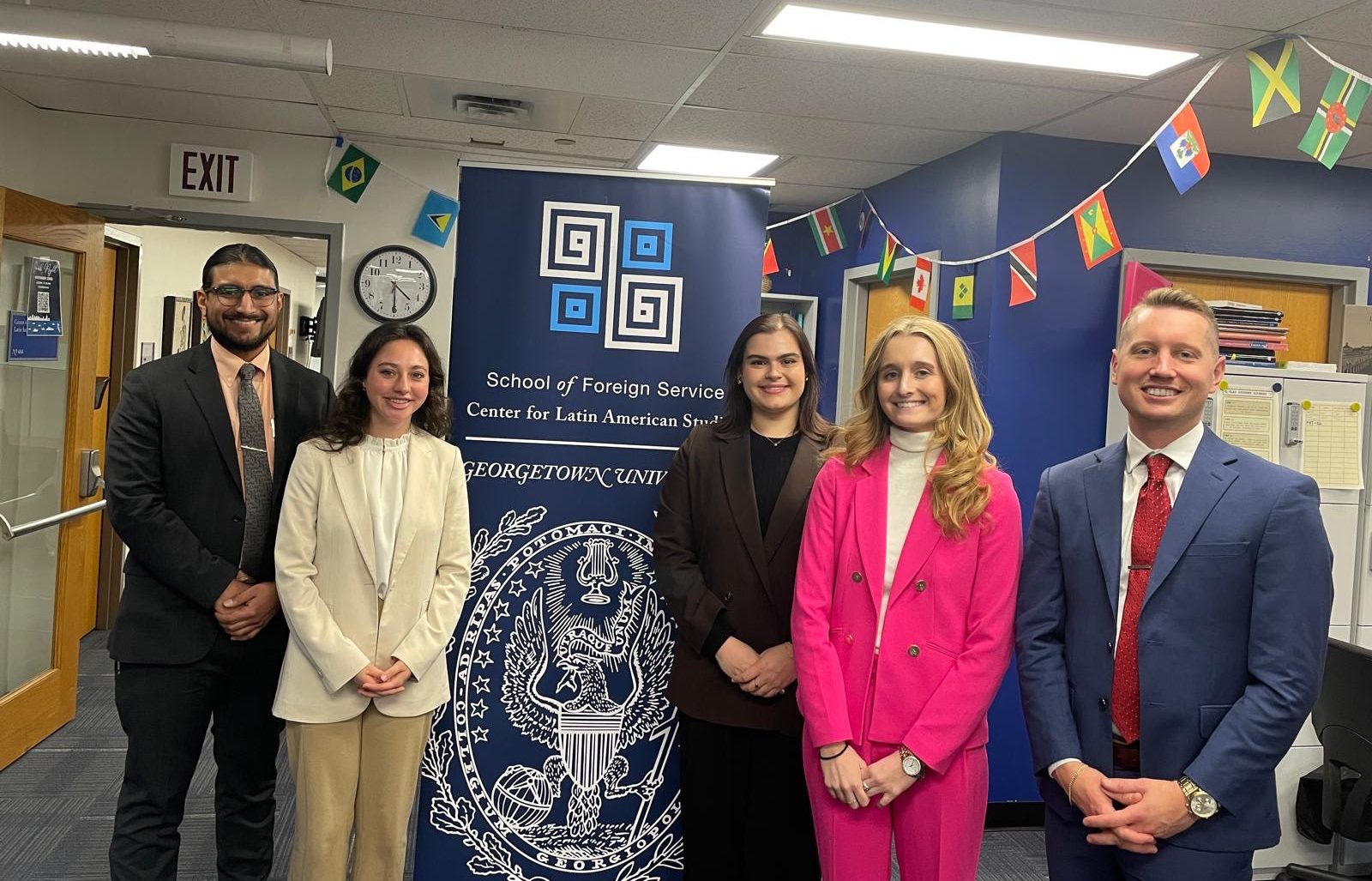
CLAS Fall 2024 Capstone Presentations
On December 12, 2024, five second-year master’s candidates in the Center for Latin American Studies (CLAS) presented their capstone projects to peers, faculty, and industry professionals.
Isabelle Boggs and Gabrielle Boyd presented on Brazil’s civil-military relations, analyzing shifts in the Armed Forces’ conduct and political engagement from 2017 to 2023. Their methodology included role and rights analysis, executive leadership analysis, and media analysis. Key topics covered were military actions, executive and civilian impacts on the Armed Forces, and military responses to significant events. They concluded that the military’s closer ties to the Executive undermined democratic checks and balances. Their media analysis highlighted concerns about the military’s growing influence in governance. Recommendations included a constitutional amendment, a civil-military defense scholarship program, and a Special Transparency Report by the Comptroller General. They emphasized the broader implications of their findings for civil-military relations and regional governance.
Jake Patrick Collins presented on how the international community can best support CARICOM’s efforts to improve its criminal justice system—which saw deterioration in response to the COVID-19 pandemic and climate change— through corrections reforms. He outlined the challenges preventing CARICOM’s implementation of data-driven reforms and called attention to the global community’s failure to prioritize the CARICOM penal system. He overviewed his methodological approach, including a qualitative and quantitative survey to five CARICOM states, the most comprehensive regional corrections data collection effort since 2018, and presented its findings. During the presentation, he argued how reducing pre-trial detention for non-violent offenses in these five CARICOM states could provide more than .5 million USD in cost-savings of previously committed budget which could be reinvested into the corrections sector to fund the implementation of Nelson Mandela Rules-aligned reforms. Finally, he conveyed how the CARICOM region can be a global model on how to reduce the longstanding disconnect between penal realities and international corrections standards.
Cate Howell and Rafael Angel Nuñez Jr. presented on the implementation of ILO 69—a landmark convention that outlines specific and key rights to indigenous and tribal communities— in Chile and Ecuador, with a focus on determining whether explicitly granting indigenous rights into a country’s jurisprudence actually protects indigenous rights. They provided some brief historical, political, and legal background on Chile and Ecuador, as well as described their methodology of legal analysis. Ultimately, they found that Ecuador and Chile’s courts and overall legal jurisprudence have solidified similar protections for indigenous groups: Ecuador through codifying rights in the constitution and Chile through interpreting rights to consultation via ILO 169. However, in both countries, cases with greater financial implications were almost always dismissed, implying a willingness of the Court to succumb to financial pressures. Next, they analyzed the specific challenges in both countries, and provided accompanying recommendations. Finally, they outlined the broader implications of their study for indigenous rights in Latin America.